Over the past decade, I’ve had the joy of putting together teams—three times in the formal world of work and three more in the down-to-earth vibe of community projects. And let me tell you, it’s been a blast. I’ve not only learned the ropes but also had the chance to champion DEIB (Diversity, Equity, Inclusion, and Belonging)—which, in plain English, means making sure everyone feels welcome and valued. In teams (regardless what department), there are only two key points we need to have first: First is, we need to understand the nature of the organization and industry. Second is, we need set the right expectation between budget, goal, and process.
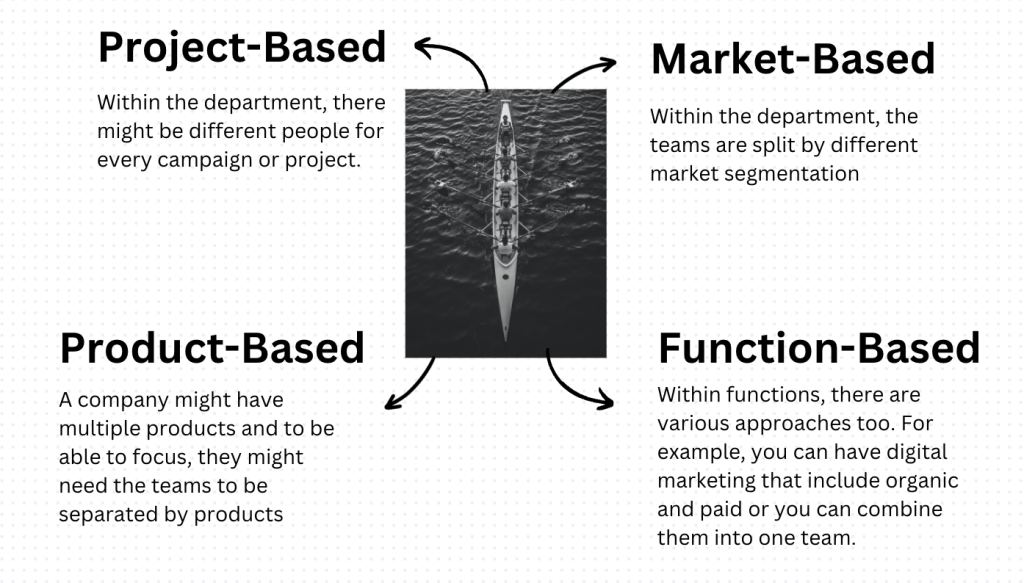
Professionally, I have built marketing teams, so I will write more from that perspective. Starting a marketing team from scratch is akin to embarking on a thrilling adventure, each step carefully chosen to lead you to success. The journey begins with understanding the unique needs of your organization, and the right blueprint for your marketing team can be influenced by several factors. In this post, we’ll explore four distinctive categories to build your marketing dream team: Project-Based, Functions-Based, Market-Based, and Products-Based.
1. Project-Based
In a project-based approach, your team is tailored to the needs of specific campaigns or projects. This agile setup is perfect for startups with sporadic or seasonal marketing needs, allowing you to collaborate seamlessly with other teams or departments. Think of it as assembling a superhero squad for each mission – from content creation to social media blitzes. One main challenge that usually happens with this setting is confusion and miscommunication, because from one project to another, it might consists of different individuals. To minimize this to happen, need to have strong communication tools and flows.
Questions to Consider:
- How many campaigns or projects in a year?
- How many people would you need to work on one project?
- What skills do they need to have?
- Which departments will we need to collaborate with for maximum impact?
- How can we ensure fluid communication between project teams?
2. Functions-Based
A functions-based approach is the go-to for many industries. Here, you build your team around specific functions within the marketing department – digital marketing, creative, branding, acquisition, and more. It’s like having a well-orchestrated symphony, each instrument playing a crucial role in creating a harmonious melody. There are still various ways within this approach, for example, one organization might need to split between digital paid and digital organic, some might need to combine into one digital team.
Questions to Consider:
- What specific marketing functions are critical to our business objectives?
- How many people do we need for each role?
- How can we ensure collaboration between different functions for a cohesive strategy?
3. Market-Based
For businesses targeting multiple and distinct market segments, a market-based approach is key. This setup allows you to customize your strategies according to the unique needs and preferences of different markets. It’s akin to having several arrows in your quiver, each aimed at a different bullseye. This does not always have to be different regions or countries, but different market can mean different segmentations and they all are big and important segmentations to handle. For example, a computer and consumer electronic company, just within one same laptop product, they can have multiple markets, ranging from students to workers where the approach will totally be different and it might require separated teams when the market is so big.
Questions to Consider:
- How diverse are our target markets, and what unique strategies do they require?
- Are there regional or demographic nuances we need to consider?
- How can we ensure a consistent brand image while catering to varied audiences?
4. Products-Based
Tech companies and FMCG giants often face the challenge of managing a vast array of products. In a products-based setup, teams are structured around specific products or product lines. It’s like having mini-marketing teams dedicated to each unique offering.
Questions to Consider:
- How extensive is our product portfolio, and do we need dedicated teams for each product?
- Are there synergies between certain products that can be leveraged for efficient marketing?
- How can we ensure consistent brand messaging while promoting individual products?
Finding Your North Star: Questions to Guide Your Team Formation
Before embarking on your team-building journey, consider these key questions:
- Budget Constraints: What is the budget allocated for marketing resources, and how can it be optimized for maximum impact?
- Growth Speed: How fast does the company want to grow, and what team structure aligns with that growth trajectory?
- Industry Dynamics: What industry-specific challenges and opportunities impact the structure of your marketing team?
- Organizational Needs: What specific needs does your organization have that can be addressed through a tailored marketing team structure?

Some of the marketing roles that might trigger you to question whether you need some of these specific roles or not:
- SEO: If you need to build your presence or visibility online, you would need this person. This can be a team or a person. They need to have a good balance between technical skills and creative skills in writing content.
- Digital Performance: This can also help to build online presence, the difference is this requires way more budget than SEO. This is the faster lane compared to SEO, but when the budget is stopped, there is really no footprints left. They also need to have a good balance between technical and creative skills.
- Social Media Content: You might need one or more than one person, depending on how aggressive you want to be on social media and what channels you need to use. They need to be more creative than analytical. If you get the balance between those two skills, it would be the most ideal.
- Copywriter: This person can help in crafting various copywriting for various needs, from campaign requirements, to blog content, to even support social media content.
- Campaign: Basically this is a project management team (or can also be one person). It is required to have good organization and collaboration skills. They need to understand the nature and landscape of marketing tools, channels, and audience behavior.
- KOLs: With companies that use a lot of KOLs approach, you might need a dedicated person to handle this. Rather than working with a third party who manage hundreds of KOLs, some companies might want to consider to manage in-house so the content quality can be maintained.
- B2B: Some companies also have B2B or even bigger in B2B area. In this case, it would be more ideal to have a dedicated team (or a person) to handle this. This can be a quite different approach with B2C, they might need different supports within the team. It is important for the person to understand marketing landscape and nature too, especially within the industry.
- Branding: This person or team should focus on building the brand. They need to have a good sense of audience behavior, interest, preference while also have information about the demography, location, to be able to create a strategy that fits to the audience and ensure more memorability.
- PR: Some companies might not need this, some might combine with Branding, some might combine with Corporate Marketing. It really depends on the needs. Generally, a PR person should have good relationships with media, they have understanding of the brand values and can help to uplift the brand with various approaches.
- Graphic Designer: This one is pretty straightforward. Especially these days, where almost everything is visual. This person or team should understand the brand guidelines for visual and bring the values into their creation.
- CRM: Mainly to handle communication with existing customers. This requires technical experiences using specific tools, but also some creativity in creating the messages. They also need to have a good understanding about retention, drop-offs, customer engagement or activities, etc.
- Product Marketing: They should focus on campaigning or communicating about the products. Brand and product are two different things. Brand is more on values, vision, mission, and product is very tactical, user benefits, etc. The person/ team should have a good understanding overall about marketing, but more importantly, they have to excel the product itself.
- Marketing Analytics: If your strategy includes a lot of data, you might consider to have Marketing Analytics person, where they would handle all data and give good analysis. Specifically if you do a lot of digital marketing, it requires a lot of A/B test and analysis to move forward and implement better planning and targeting.
- Employer Branding: This can help a company to be more visible and have better positioning among prospective employees. Some companies, combine this position with other position like Branding or PR, because it is similar. You might want to consider this as a separated role if the company is so big that you need to attract a lot potential talents.
- Corporate Marketing: Some companies take this role the same as PR or Branding, some companies make it different to tackle more partnerships or government relations.
- Partnership: If you plan to have many partnerships, you might want to have a dedicated person. For example, there are businesses where they collaborate with a lot of different payment gateways or wallets or banks, where promos can come every now and then and for different offers. This kind of activity can be included as part of Partnership’s work too.
Building a marketing team is not a one-size-fits-all endeavor. It’s about crafting a team that aligns seamlessly with the unique DNA of your startup. Whether project-based, functions-based, market-based, or products-based, the key lies in understanding your organization’s needs and assembling a team that can turn those needs into success stories. After all, the right team isn’t just a collection of individuals; it’s a symphony of talents working in harmony towards a shared goal.
 Cinthya
Leave a comment